
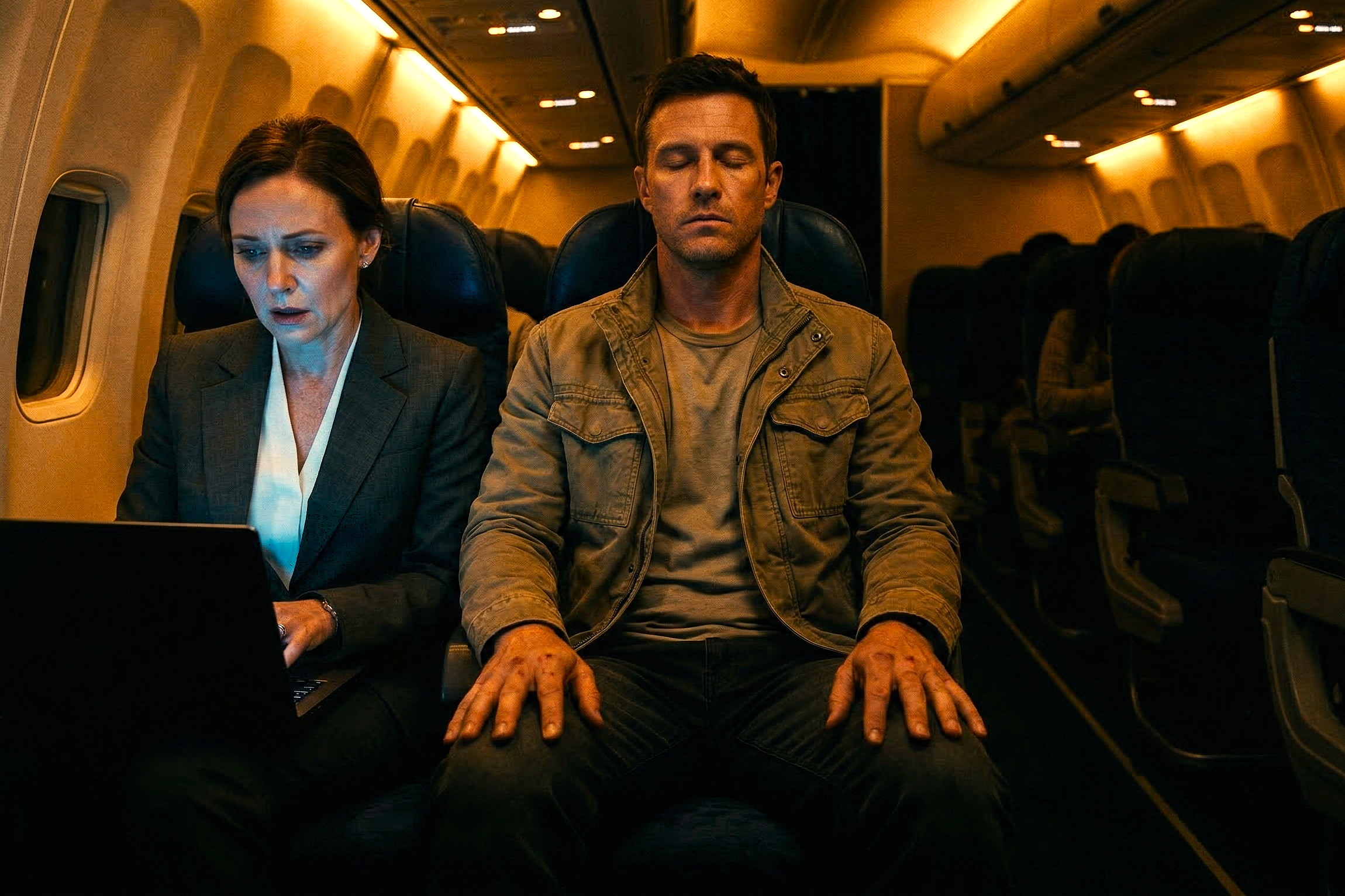
Some intersections are engineered by algorithms. Others are born of pure chaos. But the most transformative moments are those that feel like a cosmic correction, disguised as a mechanical delay and a middle seat in the back of a crowded cabin.
Adrienne Vance had forged her empire in the fires of the aerospace industry. At thirty-nine, she was the formidable CEO of Aegis Systems, a titan in satellite surveillance and orbital defense. Her name was synonymous with a “no-failure” policy. In the glass towers of Chicago and the high-security corridors of London, Adrienne was a woman who moved through the world like a kinetic weapon: fast, focused, and utterly detached from the collateral damage of her own exhaustion.
She hadn’t felt the sun on her skin without checking a weather-tracking app in half a decade. Every relationship was a transaction; every hour was a battle for market dominance.
When her Gulfstream was grounded in Singapore due to a technical glitch, Adrienne found herself shoved into the indignity of a commercial flight to San Francisco. The suit she wore cost more than the row of seats she occupied, and her jaw was set in a permanent line of defensive irritation as she opened her encrypted laptop before the “fasten seatbelt” sign had even dimmed.
The Fortress and the Calm
Adrienne lived in six-minute increments. Her life was a series of tactical strikes against competitors and relentless negotiations with Ministry of Defense officials. She was the woman who never blinked.
But as the flight leveled out over the dark expanse of the Pacific, the man in seat 18B became impossible to ignore. Kaelen Reed was the antithesis of Adrienne’s frenetic energy. He didn’t have a laptop. He didn’t have noise-canceling headphones. He sat with a grounded stillness that felt like a physical weight. His clothes were rugged—a faded canvas jacket and boots that had clearly seen the dust of continents Adrienne only viewed via satellite imagery.
His hands were the giveaway: calloused, scarred, and steady. They were the hands of a man who fixed what was broken, not someone who managed the fixing from a boardroom.
When the aircraft hit a pocket of severe atmospheric turbulence, the cabin erupted in a chorus of gasps. Adrienne’s tablet slipped from her tray, hurtling toward the floor. Before it could impact, Kaelen’s hand moved—not with panic, but with a predatory, practiced efficiency. He caught it mid-air and handed it back without a word.
“Thank you,” Adrienne managed, her heart hammering against her ribs.
“The air is always thinnest right before the currents stabilize,” Kaelen said. His voice was like a low-frequency hum, steadying the static in her brain. “Don’t fight the drop. Lean into it.”
Adrienne nodded, intending to return to her spreadsheets, but for the first time in years, the numbers on the screen felt like a foreign language. The adrenaline that had fueled her for a decade was finally, terrifyingly, running dry.
The Unplanned Rest
In the dimmed glow of the night cabin, Adrienne’s defenses finally crumbled. The white noise of the engines became a lullaby. Her head heavy with the weight of a thousand billion-dollar decisions, she began to drift. Without realizing it, her shoulder relaxed, her head tilted, and she found sanctuary on the solid, unmoving shoulder of the stranger beside her.
She slept for four hours—the only dreamless, restorative sleep she had known since she was a child.
When she jolted awake, she found a rough wool coat draped over her like a shield. Kaelen was reading a worn topographic map by a dim overhead light.






One Comment on “The Altitude of Grace”