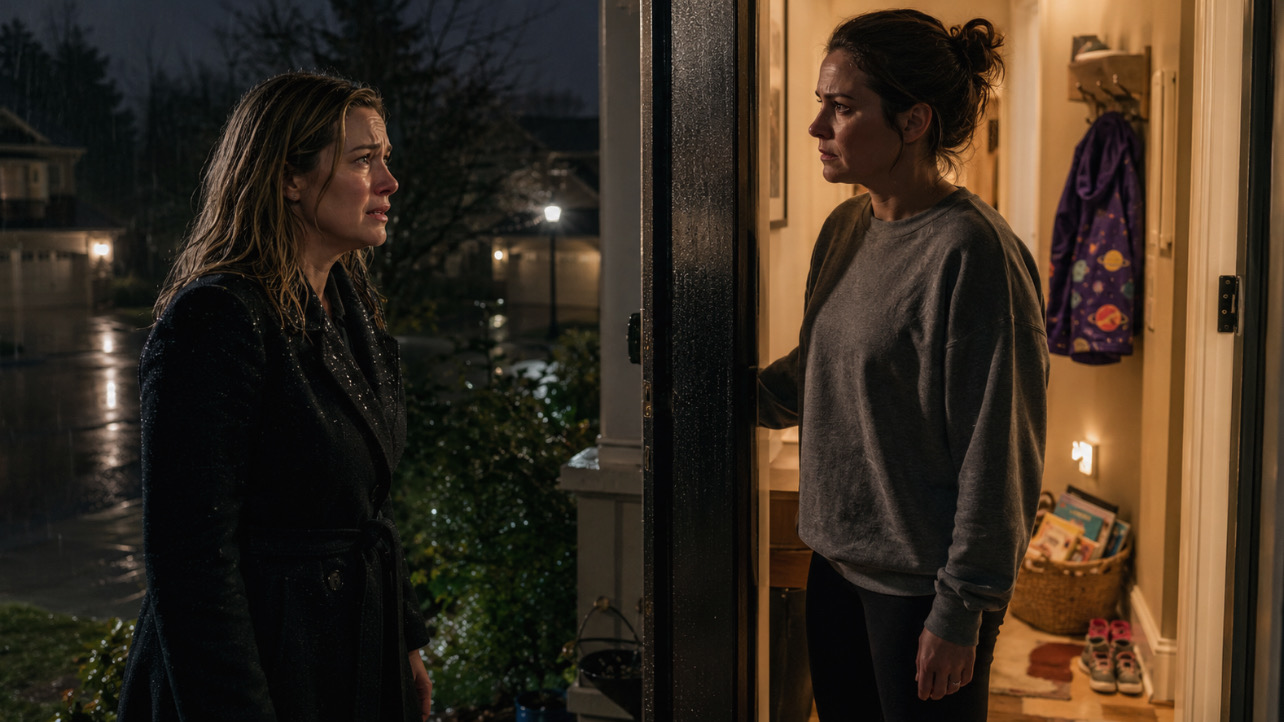
On Briar Glen Court in Lake Oswego, the sound of Caroline Vale’s heels against the rain-slick pavement felt wrong.
The entire neighborhood seemed designed to keep unpleasant things away. Cedar trees stood black against the November sky. Hedges sat trimmed and glossy beneath the rain. Porch lights glowed behind wet glass. A few houses still had sagging pumpkins by their steps, but most of the street was dark and still, wrapped in the kind of silence wealthy people paid extra to own.
Caroline sat behind the wheel of her black Audi, staring at the pale blue Craftsman house at the end of the cul-de-sac.
This was the house.
It had taken six months, a discreet investigator, and more courage than she wanted to admit to find it. Still, she checked the number again, because some part of her wanted the address to be wrong. Some part of her still wanted fate to make the decision for her.
It didn’t.
She could still leave.
Leaving had always been the thing she was best at. She had left the hospital. Left the county. Left the apartment where the rent was always late and the refrigerator hummed louder than the television. She had left every version of herself that looked helpless, frightened, or poor.
Then she built a life expensive enough to pass for peace.
A company. A downtown office. A house with steel-framed windows and imported stone. Staff. Investors. Press quotes. The kind of life people respected because they could measure it.
And for years, she had fed herself the same lie in different forms.
Not yet.
Not yet, when I’m stable.
Not yet, when I have money.
Not yet, when I’ve built something.
Not yet, when I can come back as someone a child could be proud of.
Tonight, there was nothing left to hide behind.
Caroline stepped out into the rain, pulled her wool coat tighter around her body, and walked up the path. Faded chalk stars still marked the edge of the walkway, half-washed away by the weather. At the top of the steps, she caught her reflection in the glass beside the door.
Perfect hair. Tailored coat. Composed mouth.
The face of a woman who had trained herself never to look desperate in public.
Then she rang the bell.
The chime sounded softly inside.
A few seconds later, she heard footsteps. Not rushed. Not nervous. Just familiar, lived-in footsteps crossing through a house where routine mattered.
The door opened on the chain.
The woman on the other side wore black leggings, wool socks, and an old University of Oregon sweatshirt. Her hair was clipped up carelessly, loose strands curling around her face. Warm hallway light fell over one shoulder.
Behind her, Caroline saw a night-light glowing low against the baseboard and a tiny purple raincoat with planets on the pockets hanging by the wall.
“Can I help you?” the woman asked.
Caroline had rehearsed this moment all the way from Portland. In the car, she had been careful, measured, prepared.
But the sight of that hallway, that raincoat, that domestic warmth, knocked every line out of her head.
“You don’t know me,” she said, her voice already unsteady, “but seven years ago, in Multnomah County, you adopted my daughter.”
The woman’s face went completely still.
For a moment, neither of them moved.
Then the woman said flatly, “My daughter is asleep.”
The words struck Caroline like a slap.
My daughter.
Not the child. Not the girl. Not even your daughter, said with distance.
My daughter.
Caroline swallowed hard.
“Please,” she whispered. “I just want to see her.”
The woman stared at her for another second.
“What’s your name?”
“Caroline Vale.”
Recognition flickered across the woman’s face. Faint, but unmistakable.
So the name had survived. Somewhere in this house, in some folder or legal box or archived email, Caroline still existed on paper.
The woman closed the door, undid the chain, then stepped outside. She pulled the door nearly shut behind her, leaving herself on the porch with Caroline and keeping the warmth inside where it belonged.
“My name is Nora Bennett,” she said. “And what exactly do you think you’re doing?”
Caroline opened her mouth, but Nora cut her off.
“No. Seriously. What is this? You tracked down my address, drove here at night, and rang my doorbell after my child was already in bed. What kind of ending did you imagine?”
“I know this is unfair—”
“Unfair?” Nora gave a sharp, disbelieving laugh. “That’s the word you chose?”
Rain tapped against the porch railing. Somewhere down the block, water rushed into a storm drain with a hollow metallic sound.
“I didn’t know how else to do it,” Caroline said.
Nora stared at her.
“You didn’t know how else to do it?” Her voice dropped, harder now. “Lawyers exist. Counselors exist. The agency existed. Email existed. You didn’t run out of options, Caroline. You skipped all of them and came to my house.”
“I was scared.”
“So was she,” Nora shot back. “She just happened to be a baby.”
The words landed so hard Caroline physically flinched.
She tried again.
“I was twenty-four. Her father disappeared before she was born. My mother told me not to come home unless I came home alone. I had nowhere stable to go. Some nights, I was sleeping in my car.”
Nora’s expression changed, but only slightly.
Not softer.
More focused.
“I’m sorry that happened to you,” she said. “I really am. But do not stand on my porch and tell me a sad story as if it erases what came after.”
“It doesn’t erase it.”
“Then what does it do?”
Caroline looked past Nora’s shoulder toward the narrow sliver of hallway she could still see. Family photos were clipped beneath a mirror.
A little girl in rain boots.
A little girl holding a carved pumpkin.
A little girl grinning with one front tooth missing.
Seven years, pinned to a wall in snapshots.
“I built a life,” Caroline said too quickly. “I have a home now. I have money. I can give her things now that I couldn’t give her then. Good schools, travel, security—anything she needs.”
Nora’s face hardened instantly.
“Oh my God,” she said. “You really came here thinking this was a sales pitch.”
“It’s not that.”
“It sounds exactly like that.”
“No. I’m saying I can finally—”
“What?” Nora snapped. “Compete? Upgrade her? Improve her situation?”
“That’s not what I meant.”
“Then say what you meant.”
Caroline’s breath caught.
She had spent years in negotiation rooms, speaking under pressure and turning weakness into language no one could use against her. But standing here in the rain, in front of a woman wearing socks and a college sweatshirt, she felt stripped down to the ugliest version of herself.
“I meant,” she said, her voice shaking, “that I’m not that woman anymore.”
Nora’s eyes did not leave her face.
“That woman,” she repeated. “You mean the woman who signed away her baby and vanished?”
Caroline shut her eyes for a second.
“Yes.”
Nora’s voice lowered.
“The funny thing is, we actually tried very hard not to hate you.”
Caroline looked up.
Nora folded her arms against the cold.
“The agency told us you might want contact. They said you were overwhelmed, scared, maybe not ready. So we did exactly what they told us to do. We wrote letters. Every month at first, then every couple of months. We sent photos. School pictures. Birthday pictures. Videos. We even set up a private email account just for updates, in case regular mail felt too formal.”
Caroline felt the blood drain from her face.
Nora saw it happen.
“Yeah,” she said. “You didn’t know that?”
Caroline said nothing.
“We kept that account active for three years,” Nora continued. “Three years, Caroline. We sent updates into a void because we were told maybe one day you’d be ready. Do you know how many replies we got?”
Caroline’s lips parted, but no sound came out.
“None,” Nora said. “Not one.”
Rain slipped off the edge of the porch roof in a steady silver line.
“I couldn’t open them,” Caroline whispered.
Nora stared at her as if she had spoken another language.
“I knew if I opened them,” Caroline said, “it would make everything real. I kept telling myself I’d look when I was stronger. When I had my life together. When I could handle it.”
Nora let out a breath that was almost a laugh, except there was nothing amused in it.
“You’re kidding me.”
“I’m not.”
“You couldn’t open a picture, so instead you disappeared for seven years?”
“I was ashamed.”
“And what do you think that shame cost everybody else?”
Caroline looked down.
Nora stepped closer.
“Do you know what it’s like to sit in a rocking chair at two in the morning with a screaming baby and wonder if somewhere out there another woman is grieving her? Do you know what it’s like to love a child that much and still leave room in your mind for the fact that one day she might