Kate was headed to Seattle with guilt pressing on her chest. Then a stranger’s abandoned bag pulled security to her gate and revealed a heartbreaking message she could not ignore.
By the time I reached Gate 22, I already felt like I had been emptied out and left somewhere between the parking garage and security.
I was 36 years old, but that morning, I felt like a scared kid pretending to be an adult.
I sat alone near the window with a coffee cooling between my hands. I had bought it because I needed something to do with myself.
Something normal.
Something that made me look like every other traveler waiting for a flight instead of a daughter who had ignored three missed calls from her mother and was now flying to Seattle because the words had finally come.
“Your mother’s condition is getting worse.”
My brother, Owen, had said it gently, which somehow made it worse.
“She’s been asking for you, Kate.”
I had stared at my phone after that call for a long time.
I wanted to tell him I had been busy.
I wanted to say work had been brutal, that life had been loud, that Mom and I had not known how to speak without hurting each other for years.
But all of that sounded small once someone said the word “worse.”
So there I was, sitting at the airport, staring at coffee I had no intention of drinking, while my phone sat facedown beside me like it was something dangerous.
The airport buzzed around me. A toddler cried near the charging station. Suitcases rolled over the tile in steady waves.
Someone laughed too loudly behind me.
Above us, a calm voice announced another delay, as if delays were not capable of ruining people from the inside out.
I kept my eyes on the floor until a shadow stopped beside my chair.
“Excuse me.”
I looked up.
A man stood there, late 50s maybe, wearing a gray jacket that looked wrinkled from too many hours of travel. His hair was thin and silver at the temples. His eyes were tired, not just sleepy, but worn down in a way I recognized too easily.
In his hand was a black travel bag with a strange shape.
It was not huge, but it looked heavier than it should have been.
His phone rang again, sharp and impatient.
“Could you watch this for just two minutes?” he asked politely after glancing down at his ringing phone. “I need to step away.”
I hesitated, just for a second.
Maybe if I had been less tired, I would have said no. Maybe if my head had not been full of hospital rooms and unanswered calls, I would have remembered every airport warning I had ever heard.
Do not accept bags from strangers.
Do not leave luggage unattended.
But he looked harmless.
More than that, he looked desperate.
“Can you just keep an eye on it?” he asked. “I’ll be right back.”
Then he winced like he knew he was asking too much.
“I’m sorry,” he added quickly. “I really am. It’s just an important call.”
The phone kept ringing.
“I’ll be right back,” he said again.
I felt sorry for him. That was the truth. He reminded me of someone who had been carrying too many things for too long and had finally run out of hands.
So I nodded.
“Sure,” I said. “That’s fine.”
“Thank you,” he breathed. “I’m sorry.”
He set the bag beside my chair and hurried away, phone pressed to his ear, before he even cleared the row of seats.
At first, I barely thought about it.
I watched him walk toward the windows near the next gate. He turned slightly, his shoulders hunched as he spoke into the phone. Then a group of passengers crossed in front of him, and I lost sight of his gray jacket.
Two minutes passed.
Then five.
Then ten.
I checked my phone once, saw my mother’s name still sitting there in the missed call list, and locked the screen again. My thumb hovered over it, but I could not make myself press call.
“Boarding for Flight 1847 to Denver has been delayed,” the overhead speaker announced.
A baby screamed nearby. Someone muttered, “Of course.”
I shifted in my seat and looked toward the windows again.
The man was not there.
The black bag sat beside me.
Ten minutes turned into twenty. Twenty turned into thirty.
Little by little, people around me started noticing the bag too.
A woman seated two rows away looked at it, then looked at me. Her face changed in the smallest way. She leaned down, whispered something to her little girl, and quietly grabbed her child’s hand.
A minute later, she moved farther away.
At first, I told myself I was being dramatic. People moved seats at airports all the time. Maybe her child wanted to see the planes. Maybe she needed an outlet. Maybe none of this had anything to do with me.
Then the man sitting across from me started staring.
Not at me exactly.
At the bag.
Then at me.
Then back at the bag.
He had a newspaper folded in his lap, but he was no longer reading it. His eyes kept darting toward the black travel bag like it might move on its own.
My mouth went dry.
I turned in my seat, scanning the gate area for the man in the gray jacket.
Nothing.
No tired eyes. No silver hair. No ringing phone. No one looking apologetic as they came rushing back to collect what they had left behind.
I stood halfway, then sat back down. My legs felt weak for no reason I could name yet.
That was when I finally looked up and noticed the security cameras.
There were several near the gate. Small black domes fixed to the ceiling. I had not paid attention to them before. Why would I?
But now it seemed like every airport security camera near the gate was pointed directly in my direction.
At me.
At the bag.
My stomach dropped.
Because from every angle, it looked like the bag belonged to me.
I grabbed my purse, stepped away from the chair, then stopped. If I walked away, it would look worse. If I stayed, it looked like I was guarding it. If I touched it, I might make everything worse than it already was.
Suddenly, I could not breathe properly.
I looked around again.
The woman with the child was watching me now. The man with the newspaper stood and changed seats completely. Two teenagers whispered with their eyes fixed on the black bag.
My hands started shaking before I even realized I had decided what to do.
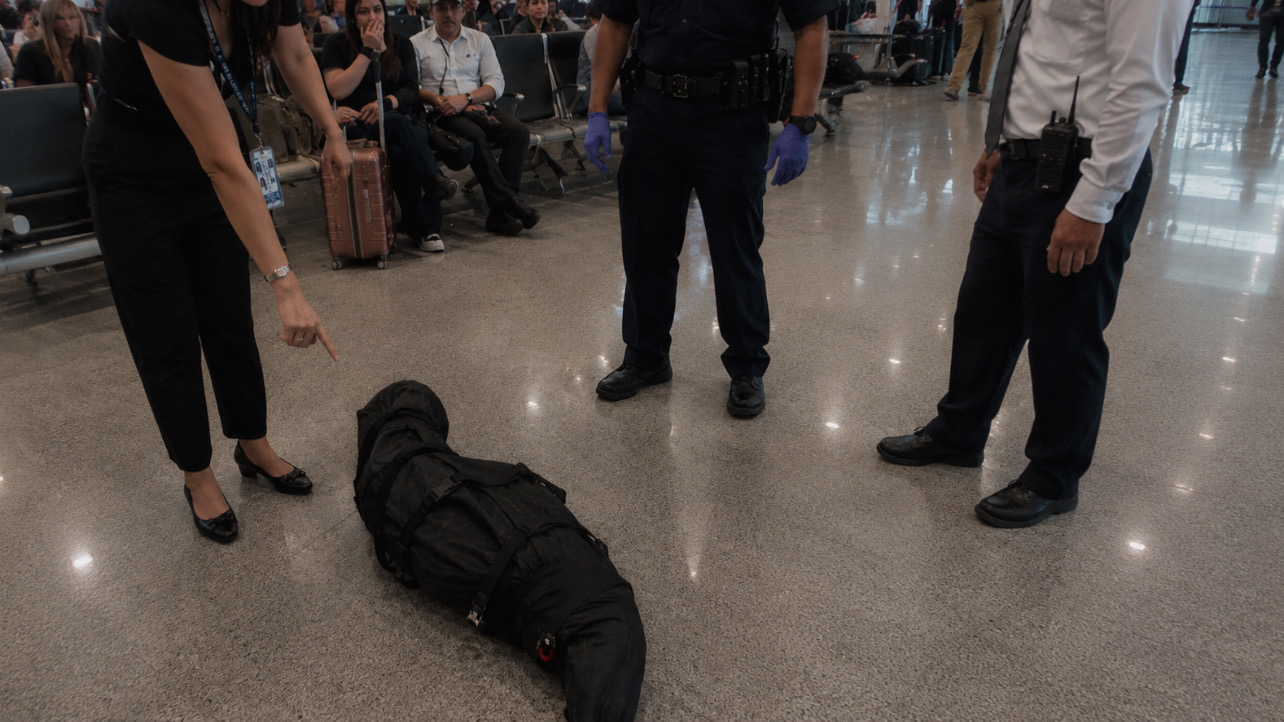
I walked over to airport security.
There were two officers near the entrance to the gate area, one speaking into a radio, the other watching the crowd with a calm expression that vanished the moment I approached.
“This isn’t my bag,” I said quietly.
The officer’s eyes moved past me.
“To which bag are you referring, ma’am?”
I pointed, and my finger trembled.
“That black one by my seat. A man asked me to watch it for a few minutes. He said he’d be right back.”
The second officer stepped closer.
“What man?”
“Late 50s,” I said quickly. “Gray jacket. Tired eyes. He had a phone call. He apologized three times. He said it was important.”