Ten years after a father-son fishing trip shattered her family without explanation, Claire had almost stopped asking what went wrong. Then her grown son came home one night, sat down at the kitchen table, and finally revealed the terrifying truth he had carried since he was eight.
I waited 10 years to hear my son tell me what happened on that fishing trip.
By the time he finally did, I had already imagined almost everything.
All I knew for certain was this:
My eight-year-old son left for a weekend at the lake with his father, excited beyond belief.
And he came back like someone had gone into him with a knife and left the wound where no one could see it.
Back then, my husband Daniel kept saying Ethan needed “real father-son bonding time.” He said it with that smug certainty he used whenever he wanted something badly enough to act like it was obviously best for everyone else, too.
At first, I liked the idea.
The night before they left, he lay out his tiny fishing vest on the bed and asked me three separate times if fish could smell fear.
I laughed and told him probably not.
He whispered, very seriously, “Good, because I think I have a little.”
That was Ethan. Sensitive in this careful, funny way. A child who worried about worms and apologized to spiders before putting them outside.
Daniel used to call him soft, and not affectionately.
That should have told me more than I let on.
When they left that Friday morning, Ethan hugged me so hard I nearly spilled my coffee.
“I’ll bring you the biggest fish,” he promised.
“I’d rather have a postcard.”
He grinned. “I’ll bring both.”
Daniel tossed their bags into the truck and honked like we were delaying a military operation.
“Come on, buddy. Men leave on time.”
Ethan’s smile faltered for a second, then he ran to the passenger side.
That was the last normal thing.
They came back Sunday afternoon.
I remember hearing the truck before I saw it and feeling relieved. I had missed Ethan. The house always felt wrong without him in it.
I stepped onto the porch smiling.
Then the passenger door opened.
Ethan climbed out slowly, holding his backpack against his chest. His face was pale in this hollow, stunned way that made my stomach turn over immediately.
“Hey, baby,” I said, already walking toward him. “How was—”
He did not look at Daniel.
He did not look at me.
He went to his room, shut the door, and locked it.
I turned back to Daniel. “What happened?”
He slammed the truck door harder than necessary. “Nothing happened.”
“Daniel—”
“He got moody. That’s all.”
I stared at him. “He’s eight.”
“And dramatic.”
He used that word whenever someone else’s pain inconvenienced him.
I went to Ethan’s room and knocked softly.
“Sweetheart?”
Nothing.
“Ethan, open the door.”
After a long time, I heard the lock click. When I stepped inside, he was sitting on the floor by his bed, still clutching his backpack. His eyes were red but dry, like he had cried until the tears stopped working.
I knelt beside him. “What happened?”
He shook his head instantly. “Nothing.”
It was the same word Daniel had used, but it sounded completely different coming from my son.
I touched his hair. “Did you two fight?”
A pause. Then: “Please don’t make me talk about it.”
My blood went cold.
Over the next few days, things got worse.
Ethan stopped speaking to Daniel completely.
Not in the theatrical way kids sometimes do when they are proving a point. He acted like his father had become dangerous to acknowledge.
If Daniel walked into a room, Ethan walked out. If Daniel asked a question, Ethan froze or looked at the floor until I answered for him.
At night, the nightmares started.
I would hear him crying through the wall and find him twisted in his sheets, breathing hard, eyes wide and unfocused. Twice, he wet the bed after nearly two years without accidents. Once I found him curled up inside his closet with a flashlight and his pillow.
Every time I asked about the trip, he whispered the same thing.
“Please don’t make me talk about it.”
So I asked Daniel.
Again and again and again.
He got defensive every time.
“He fell in the water and embarrassed himself. Maybe that’s all this is.”
“He got scared during a storm. Boys need to toughen up eventually.”
“You baby him too much, Claire. That’s the problem.”
That last one started our first real screaming match.
I remember standing in the kitchen while Ethan hid upstairs, saying, “Our son is having nightmares, and you’re standing there insulting him.”
Daniel jabbed a finger toward the ceiling. “Because he’s manipulating you.”
“With what? Terror?”
He actually rolled his eyes.
I wish I could say I left him then.
I didn’t.
I took Ethan to a child therapist instead.
He barely spoke there either. Instead, he drew a few pictures, mostly dark blue scribbles and one disturbing image of a lake with no people in it.
The therapist told me gently not to push too hard, that sometimes children protect themselves by locking an experience away until they feel safe enough to name it.
“Did he say anyone hurt him?” I asked.
“No.”
“Did he say his father hurt him?”
“No. But avoidance that intense usually means the child associates the person with overwhelming fear.”
That sentence lived in me for years.
Daniel and I divorced three years later, though not officially, because of the trip. Officially, it was “irreconcilable differences.” In reality, it was death by accumulation.
His contempt, my anger, the way he treated Ethan’s sensitivity like a defect, and the way Ethan visibly relaxed every time Daniel was away.
By then, father and son were effectively strangers anyway.
Daniel tried at first, mostly to preserve appearances. By 14, he stopped pretending there would be a relationship to repair.
I asked less as the years passed.
Partly because Ethan begged me to.
Partly because life moved.
But partly, if I am honest, because I was afraid.
I had a terrible feeling that once I knew the truth, I would have to face what my silence had cost my son.
Then last week, Ethan came home.
He is 18 now. Taller than me, lean in that half-finished young-man way, with the same thoughtful eyes he had as a child and a steadiness I did not see coming after all those broken years.
He is in college two hours away studying environmental engineering, which still makes me laugh because the boy who once refused to go near lakes now wants to protect rivers for a living.
He called that morning and asked if he could come by.
“Of course,” I said. “Is everything okay?”
A pause.
“Yeah. I just… want dinner with you.”
Something in his voice made my pulse tick upward.
He arrived just before six, hugged me too tightly, and spent the whole evening distracted. He pushed food around his plate. Answered questions half a second late. Jumped when the ice maker clattered in the freezer.
By 10, I knew something was coming.
By midnight, we were sitting at the kitchen table with only the stove light on, and Ethan looked like he was about to be sick.
Then he said, very quietly, “Mom… I need to tell you what really happened on that fishing trip.”
Every hair on my arms stood up.
I did not speak. I was afraid any interruption would make him stop.
He stared at his hands.
“For a long time, I thought if I said it out loud, it would become more real.”
My throat tightened. “Okay.”
He swallowed. “The first day was mostly normal. We got to the cabin. Dad made me carry stuff that was too heavy, but… normal for him.”
I nodded once.
“He kept saying I had to learn how to be a man. He said no whining, no crying, and no acting like a baby if I got cold or tired.”
Ethan gave a humorless little laugh.
“I remember trying so hard to be what he wanted for like six straight hours.”
I could already feel tears building behind my eyes.
He went on.
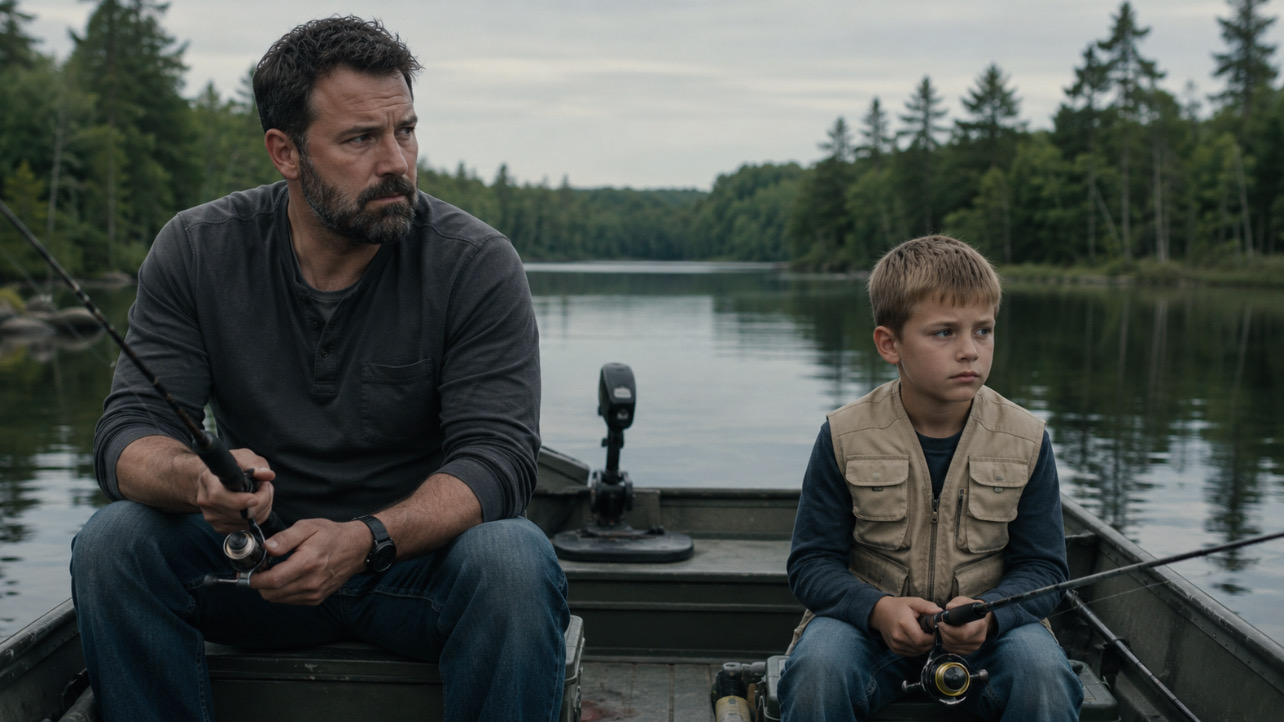
“Saturday morning, we took the boat out really early. It was still dark enough that the lake looked black. I didn’t like it, but I didn’t say anything because he was already in one of those moods.”
“What moods?”
“The kind where you can tell he wants you to fail so he can prove something.”
Ethan rubbed his palms on his jeans.
“I caught a fish first. A little one. I was excited. I thought he’d be proud.”
He looked up at me then, and I saw eight-year-old Ethan in his face so clearly it hurt.
“Instead, he got mad.”
I whispered, “Why?”
“Because I wouldn’t take it off the hook.”
I blinked. “What?”
He nodded. “It was bleeding, Mom. Just a little, but… it was flopping, and I got scared. I asked him to help.”
My chest was starting to hurt.
“He called me pathetic. Said if I couldn’t stomach letting a fish die, I had no business calling myself his son.”