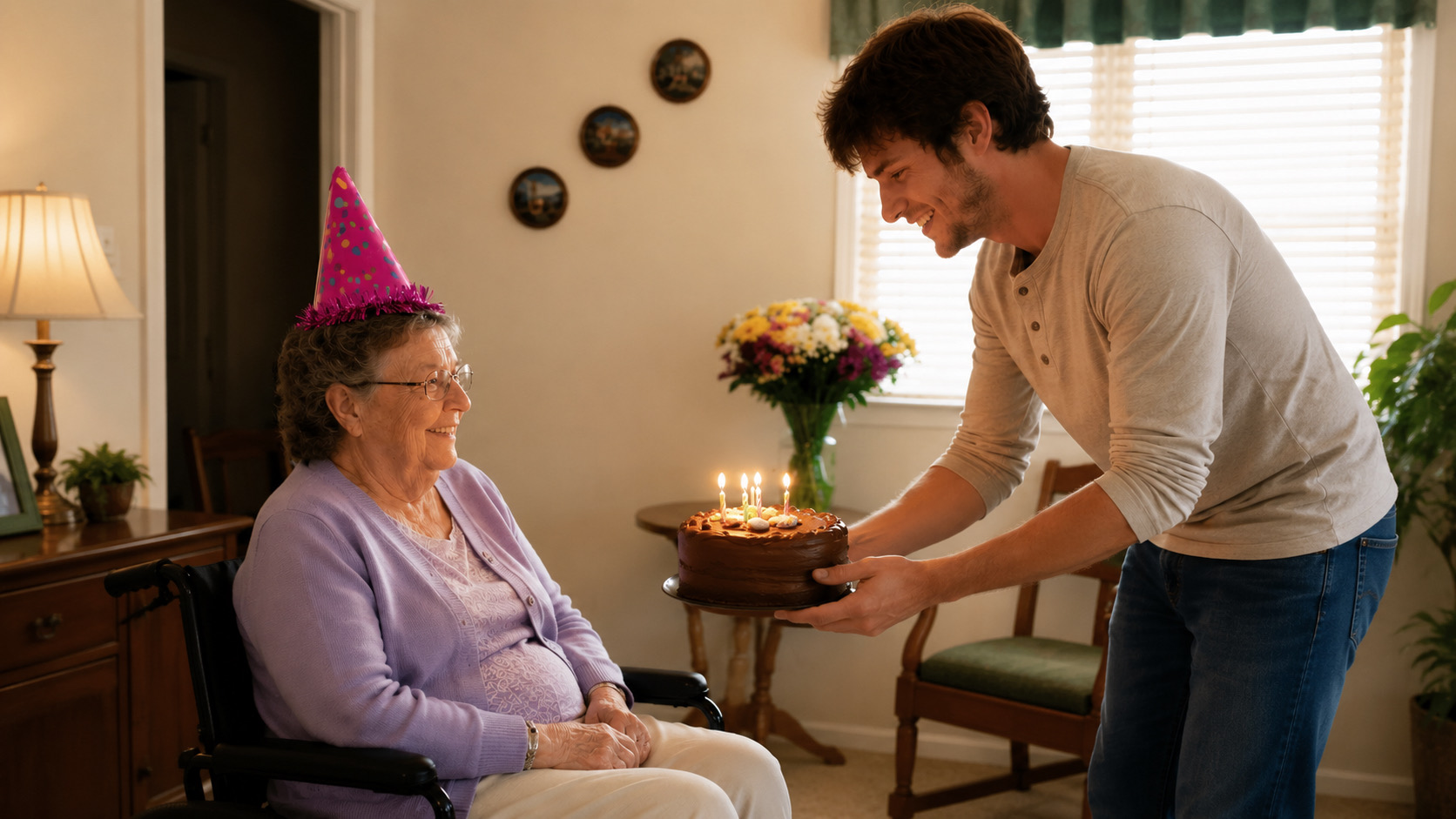
The strangest relationship of my life began with a hundred-dollar bill and a birthday cake. For ten years, an elderly woman paid me to sit beside her at the same party, in the same chair, and never once explained why. When I finally learned the truth, it changed everything I thought I knew about her.
I was 18 when an elderly woman offered me $100 to attend her birthday party. At the time, I thought she was joking.
I was standing outside a grocery store, counting the coins in my pocket and trying to decide whether I could afford both bread and milk.
The woman approached slowly. Gray hair, neatly pressed clothes, kind eyes.
“Excuse me,” she said.
I looked up. “Yes?”
She smiled, then asked the strangest question I’d ever heard. “Would you like to earn $100 for attending a birthday party?”
I blinked. “What?”
“A birthday party.” She repeated it as though it were perfectly normal. “I’ll pay you $100.”
My first thought was scam. My second thought was that rent was due in four days.
“When?”
“Saturday.”
I studied her face. She looked sincere, normal even, just unusual.
Finally, I nodded. “Okay.”
Her smile widened. “Wonderful.”
That Saturday, I showed up at the address she’d given me. The house wasn’t extravagant, just warm and comfortable, the kind of place where people actually lived.
Inside, about a dozen guests chatted over coffee and cake. Nobody seemed surprised to see me.
That should have been my first clue.
The woman introduced herself as Mrs. Hale, then led me directly to a chair beside hers, as though she’d been saving it.
The party itself was pleasant enough. People talked, laughed, shared stories.
At the end of the evening, Mrs. Hale handed me an envelope. Inside was $100, exactly as promised.
Then she asked, “Do you think you’ll be available next year?”
I laughed. “You plan your birthdays that far ahead?”
“I do.”
A year later, another invitation arrived. Then another. Then another.
By the fourth year, it felt normal. By the sixth, it felt expected. By the tenth, Mrs. Hale had become one of the most important people in my life.
Which was strange, because technically, she was still a woman I’d met outside a grocery store.
The money continued. Every year she handed me an envelope, and every year I tried to refuse it. Every year she insisted, until eventually I stopped arguing.
The strange part wasn’t the money. The strange part was everything else.
Mrs. Hale remembered things.
Everything. The name of my third-grade teacher, my favorite dessert, the apartment I’d rented after college, even the date of my first promotion.
If I mentioned something once, she remembered it forever.
One year, I casually mentioned wanting a better job. Three weeks later, she called. “I heard a company downtown is hiring.”
She was right. It became the job that launched my career.
Another year, I got the flu. Nothing serious, yet somehow Mrs. Hale found out and called every day until I recovered.
Sometimes I wondered if she knew more about my life than I did.
Around year seven, I almost missed her birthday.
A project at work had exploded into a disaster, and I’d spent three straight days at the office. I called to apologize.
“I’m not sure I can make it.”
There was a pause.
“I understand,” Mrs. Hale said.
For some reason, the disappointment in her voice bothered me.
An hour later, I left work anyway.
When I arrived, she smiled and said she’d known I’d come. That was the first year I realized I wasn’t attending because of the money anymore.
The gifts started around year three. Nothing expensive, nothing dramatic. A bookmark. An old recipe card. A paperback novel. A snow globe from a town I’d never visited.
They always felt random. When I thanked her, she’d smile and say, “It reminded me of someone.” That was all. No explanation.
The seat never changed. Every birthday, the chair beside hers waited for me, and every year, somebody else ended up standing because that chair remained empty until I arrived.
One year, I finally asked. “Why am I always sitting here?”
Mrs. Hale smiled. “Because that’s your seat.” Then she changed the subject.
That answer bothered me for years.
The guests changed constantly. Neighbors came and went. Friends came and went. Even relatives came and went.
I was the only person who attended every birthday, the only constant, the only one who always sat beside her.
Sometimes I’d catch people watching us, curious, as though they knew something I didn’t.
Maybe they did.
Then came the photograph. It happened during her 81st birthday, a smaller gathering than usual.
Mrs. Hale and I were sitting together, looking through old photo albums. She turned a page, then froze, only for a second. But I noticed.
The photograph showed two young women standing beside a car. One was Mrs. Hale. The other looked strangely familiar.
Before I could study it properly, Mrs. Hale turned the page.
“Who was that?”
Her smile faded.
“A friend.”
Yet something felt off for the rest of the evening.
Later, someone mentioned an upcoming road trip, and the conversation shifted to driving routes and long hours behind the wheel.
Mrs. Hale felt unusually quiet. The change lasted only a moment, but I noticed it. Then her gaze drifted back toward the album, toward the photograph.
There was something in her expression I couldn’t quite place.
Then she forced a smile and changed the subject.
Months later, while cleaning my apartment, I found the only photograph I had of my mother, Julia. The woman who died when I was seven.
I stared at the picture, then sat down, because suddenly I knew why the woman in Mrs. Hale’s album had looked familiar.
It was my mother.
The next birthday, I brought the photograph. The moment Mrs. Hale saw it, she froze completely.
For several seconds, neither of us spoke. Then she whispered, “Julia.”
My heart started pounding.
She didn’t need an explanation. She knew exactly who she was looking at. That’s when I realized something. Mrs. Hale hadn’t approached me by accident ten years earlier. She had known exactly who I was all along.
“You knew her.” It wasn’t a question.
She nodded slowly. “Yes.”
I waited. She stared at the photograph, then back at me. “Julia was my best friend.”
I had spent most of my life knowing almost nothing about my mother, and now someone who had loved her was sitting across from me.
“What was she like?”
Mrs. Hale smiled instantly. “Stubborn.” Then, “Funny.” Then, “Far too generous for her own good.”
For the next hour, she told stories I’d never heard, about road trips, terrible apartments, bad decisions, big dreams.
For the first time in my life, my mother felt real. Not a photograph, not a memory, but a person.
When the evening ended, I expected answers. Instead, Mrs. Hale stood and walked to a bookshelf. She pulled out a framed photograph.
It showed her and my mother standing beside an old sedan.
For a moment, she stared at it.
Then her expression changed. Before I could ask why, she put the photograph away.
Then she hugged me, longer than usual, and said goodnight.
The mystery only grew. If she knew my mother, why wait ten years to tell me?
The following birthday brought no answers. Neither did the one after that.
Whenever I asked questions about my mother, Mrs. Hale answered them. Whenever I asked questions about her, she changed the subject. The more comfortable we became, the more obvious it grew that she was hiding something, not out of malice, but out of fear.
Then came the hospital.