
You do not cry the day your marriage ends. Not because you are brave or numb, but because your grief has already been spent. It bled you dry three months earlier, on the night you stood in the shadows of your own hallway and watched the man you married rehearsing a new future in the townhouse you paid for.
By the time the decree absolute slides across the polished oak table in the London solicitor’s office, your tears are an old, worthless currency. What remains is something far more dangerous: Clarity.
David signs first. He uses a heavy fountain pen—a bespoke gift you bought him for his first “partnership”—and scratches his name across the parchment with the swagger of a man signing a peace treaty he intends to break. He thinks he is escaping a sinking ship, carrying a chest of someone else’s gold. He looks at you and offers a thin, practiced smile—a polished expression that suggests he believes he has won the better part of the deal.
You sign your name beneath his, slow and clean. Five years of marriage reduced to a few strokes of ink. No children to fight over, no shared assets he can openly claim—just a tidy, legal amputation. David mistakes your silence for surrender. That has always been his favorite kind of mistake.
David was the perfect actor. He stepped into your life when your parents were lost to a sudden accident within a year of each other, leaving you with the crushing weight of Vanguard Bio-Systems and the sprawling family estate in the Cotswolds. He was the one who brought tea to your laboratory; he was the one who rubbed your temples while you navigated international patent laws; he listened just long enough to make himself feel essential.
Then, the “familial obligations” began. First, it was his sister’s tuition. Then, a “modest” expansion for his father’s country cottage that ballooned into a complete architectural overhaul. Every time you authorized a wire transfer, he would kiss your temple and whisper, “You know I’ll make it up to you.” He said it as if repayment were a sentiment, not a balance sheet.
Three months ago, the truth let itself in. David had left his tablet unlocked on the vanity, and a notification illuminated the screen from a contact saved under a gold flame: “Counting the days until we’re free, my heart.”
The message thread was a clinical autopsy of your marriage. Her name was Saffron, a twenty-four-year-old research assistant you had brought onto the Vanguard team six months prior. The messages spoke of “their” upcoming travels, “their” new flat, and how they wouldn’t have to hide much longer once “the settlement” was finalized.
When you confronted him, he didn’t falter. He didn’t offer a desperate apology. He simply looked at you with the composure of a man who had already moved out in his mind.
“I love her,” he said. It was a clean incision meant to split your life in two.
He expected a scene. He expected you to cling to the wreckage of your “love” even after he had stripped it for parts. He expected the old version of you—the one who confused a soft voice with a safe harbour.
He was wrong.
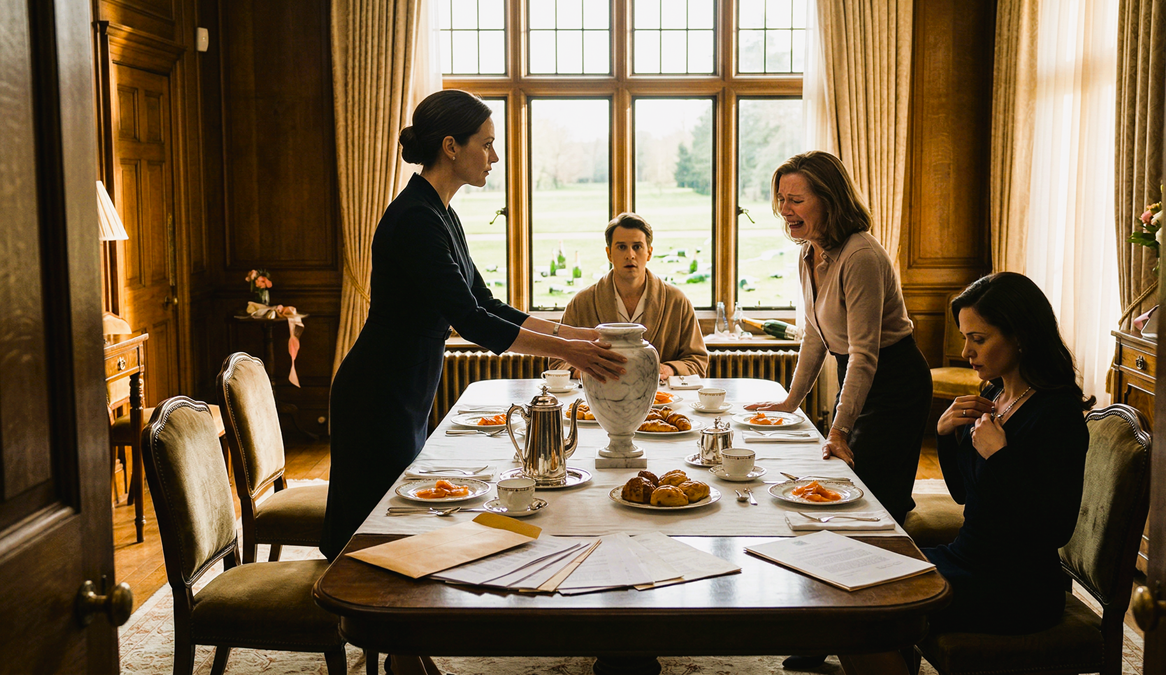
The morning after the divorce was finalized, the sky over London was the pale, sickly gray of a healing bruise. You dressed with the methodical calm of a surgeon: a charcoal-grey suit, simple studs, and a sharply tailored coat. Then, you went to the private vault and lifted a small, heavy marble urn into your arms.






One Comment on “Happiness Isn’t a Weapon—It’s What Remains.”