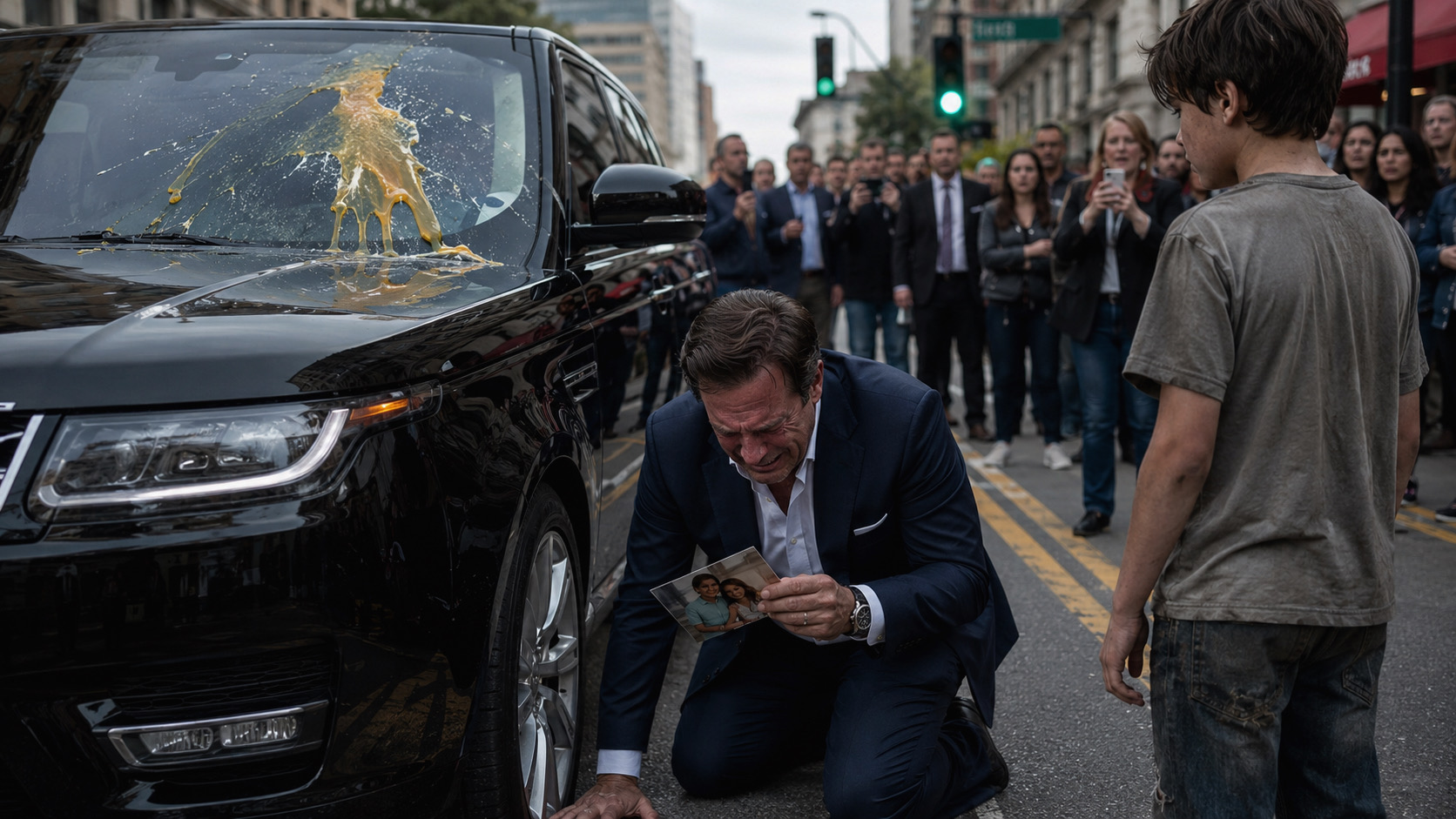
The egg hit Graham West’s windshield at the exact moment the traffic light turned green.
It exploded against the glass with a sharp wet crack, yolk and egg white spreading across the black SUV’s windshield in a yellow smear that instantly began to drip. For half a second, the city around him seemed to freeze.
Then the SUV lurched.
Tires screeched against the asphalt.
A delivery cyclist swerved near the curb. A woman outside a coffee shop gasped. A man in a gray coat looked up from his phone just as the luxury SUV slammed to a hard stop beside the sidewalk on a busy street in downtown Lexington, Kentucky.
Cars honked behind him.
Graham threw the driver’s door open and stepped out.
He was fifty-two, tall, broad-shouldered, clean-shaven, and dressed in an expensive navy suit that looked wrong against the dirty street and the dripping mess on his windshield. His face was sharp, controlled, and powerful in the way powerful men trained themselves to appear even when they were furious.
He turned toward the boy standing ten feet away in the street.
The boy was thin, thirteen at most, with a dusty face, dark hair stuck to his forehead, an oversized faded gray T-shirt, torn jeans, and worn shoes that looked too light for the cold. His hands were shaking, but he did not run.
Graham stepped toward him.
“What the hell is wrong with you?”
The boy swallowed hard.
His chest rose and fell like he had been running for miles before the egg ever left his hand.
“You abandoned us. She’s sick. She needs help..”
Graham stopped.
The anger on his face cracked, not enough to disappear, but enough to let confusion through.
Cars rolled slowly past them. Pedestrians gathered along the sidewalk. Someone near the corner lifted a phone, then lowered it when Graham turned his head.
He looked back at the boy.
“Kid… what are you talking about? Who is she?”
The boy reached into his pocket with trembling fingers.
For one tense second, Graham’s body stiffened.
Then the boy pulled out an old photograph.
It was wrinkled, slightly folded, soft at the edges from being handled too many times. He held it out toward Graham like evidence and accusation in the same gesture.
“Look at this.”
Graham took the photograph.
The city noise dulled around him.
The picture had been taken outside a diner almost fourteen years earlier. Graham was younger in it, laughing in a way he had not laughed in years. His arm was around a young woman in a yellow sundress, dark hair loose over her shoulders, bright eyes turned toward him as if the whole world had become safe because he was standing beside her.
In her arms was a baby wrapped in a blue blanket.
Graham’s hand began to tremble.
His face lost all color.
His eyes filled before he seemed to know it was happening.
“Clara… oh my God… where is she?”
Then his knees gave out.
He dropped right there on the city street, one hand braced against the asphalt, the other clutching the photograph as if it were the last piece of a life stolen from him. The boy stood in front of him, breathing hard, terrified and defiant, while traffic and strangers blurred behind them.
For a moment, Graham could not move.
Could not speak.
Could barely breathe.
Clara.
The name tore through him like something buried alive.
He had not said it out loud in years.
Not because he had forgotten her.
Because remembering her had once nearly destroyed him.
Fourteen years earlier, Clara Monroe had been twenty-two and working the late shift at a small diner outside Lexington. Graham had been thirty-eight, already rich, already watched, already surrounded by men who called themselves family and treated love like a liability.
He had met her by accident during a storm.
He returned the next day because of her smile.
After that, he found reasons to drive through Kentucky that made no business sense at all.
Clara was nothing like the women in his world. She did not care about his hotels, resorts, golf clubs, investment funds, or magazine covers. She teased him for ordering black coffee when she knew he hated it. She made him wait for a table like everybody else. She once told him, flatly, that money made boring men louder.
He loved her before he admitted it.
She was pregnant before he knew what to do with love that was real.
Then everything collapsed.
His family found out.
His older brother, Bennett, stepped in.
Bennett West had always been the one who handled problems quietly. Trust documents. Lawyers. Family reputations. Women who were not suitable. Employees who knew too much. He had their father’s patience and none of his conscience.
Graham remembered the hospital.
White walls.
The smell of antiseptic.
Bennett standing beside him in the hallway, eyes red, hand gripping Graham’s shoulder.
“I’m sorry,” Bennett had said. “The baby didn’t make it.”
Graham had tried to get to Clara.
Bennett stopped him.
“She’s gone. She doesn’t want to see you.”
Graham had not believed him at first.
Then there was a letter.
Clara’s handwriting.
I can’t do this. Don’t follow me.
He had followed anyway.
The diner was empty.
Her apartment was cleared.
Her phone disconnected.
Every door he knocked on closed gently and firmly in his face, as if someone had reached each person before he did.
Eventually, grief became anger.
Anger became work.
Work became a fortune large enough to hide inside.
For thirteen years, Graham told himself his son had died.
Now a living boy stood in front of him with Clara’s photograph in his hand and Graham’s own eyes staring out of a thin, furious face.
Graham lifted his head.
“What’s your name?”
The boy hesitated.
“Miles.”
The name hit him harder than the fall.
Miles.
Graham had once told Clara he liked that name because it sounded like a traveler, someone who could survive a long road.
Clara had laughed and said, “Then if it’s a boy, that’s his name.”
Graham pushed himself slowly to his feet.
“Miles,” he said.
The boy flinched.
“You don’t get to say it like you know me.”
Graham nodded, swallowing hard.
“You’re right.”
Miles looked angry that Graham did not fight back.
“My mom said you wouldn’t stop for a letter,” he said. “She said your people would throw it away before it reached you. She said if I ever found you, I had to make you look at me.”
Graham looked at the egg dripping down the windshield of his SUV.
Then back at the boy.
“It worked.”
Miles’s mouth trembled, but he forced it still.
“She’s in a trailer outside Ashford Farm. She’s coughing blood. She can barely stand. The clinic said she needs a hospital, but she wouldn’t go because she said if Bennett found out where we were, he’d finish what he started.”
The name changed Graham’s face.
Bennett.
Miles saw the recognition and reached into his pocket again.
This time he pulled out a small white envelope, folded and sealed with clear tape.
“She told me to give you this only if you believed the photo.”
Graham stared at the envelope.
On the front, in faded blue ink, was one word.
Graham.
Not Mr. West.
Not Graham West.
Just Graham.
He knew Clara’s handwriting.
He had known it on diner checks, birthday cards, grocery lists, and the one goodbye letter Bennett had placed in his hand years ago like a final mercy.
Graham opened the envelope with clumsy fingers.
Inside was a letter and a yellowed hospital bracelet.
Baby Boy Monroe-West.
Born alive.
Six pounds, eleven ounces.
His throat closed.