
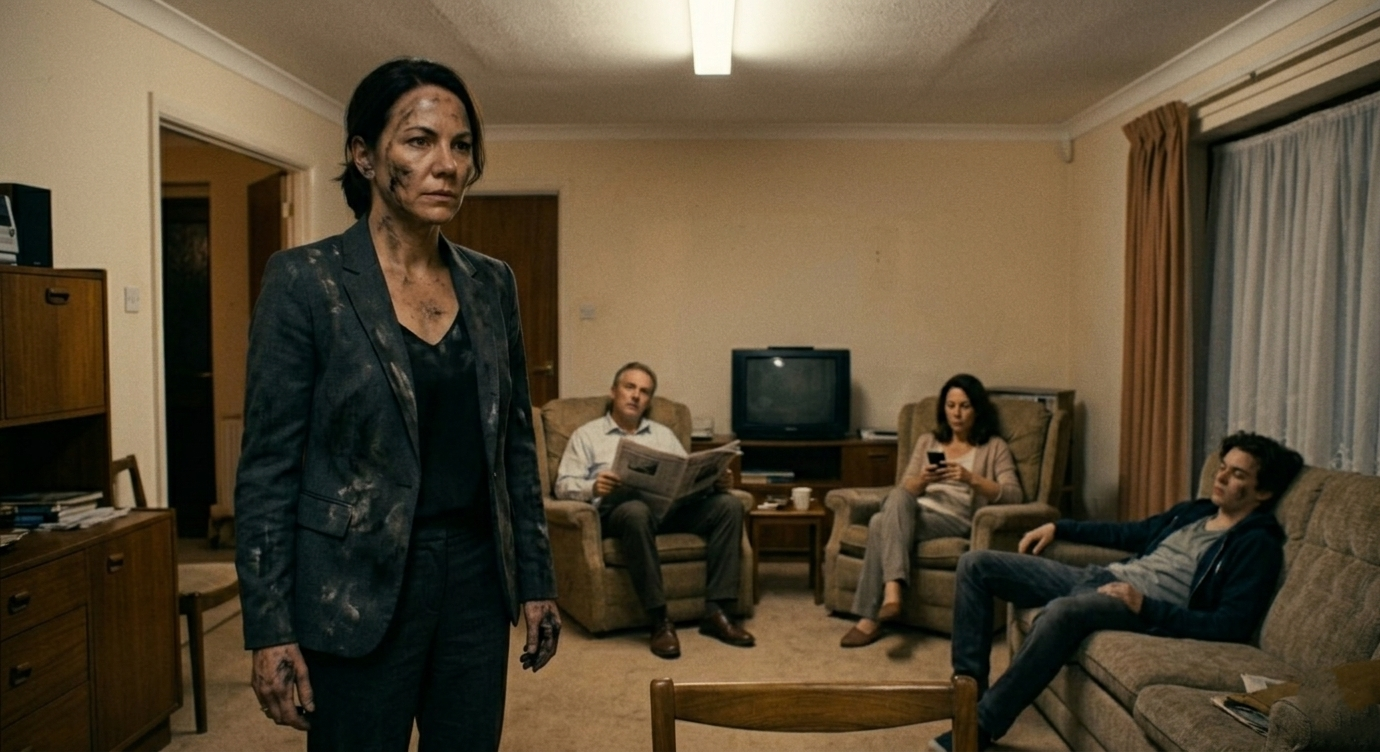
I am Clara Vance, and I was nineteen the night my world tilted. It was the evening of my hard-won gallery opening, an event my parents unceremoniously scrapped because Julian had crashed his car and felt “too fragile” to celebrate someone else’s success.
For as long as I could remember, the air in our house was tuned to Julian’s frequency. His moods were the weather we all lived by; his failures were treated as tragedies, while my achievements were handled like inconveniences. They told me I had “natural grace,” but that was just code for being expected to shrink so he could feel tall. I was taught that love was synonymous with empathy, but in our home, empathy was a one-way street where I was always the pedestrian and he was the speeding car.
The week of my exhibition, Julian lost his internship. The fallout was immediate. He snapped at dinner, “If my career is in the dirt, why are we standing around clinking glasses for her sketches?”
I expected my parents to rebuke him. Instead, they nodded. By the next morning, the guest list I had spent weeks curating was deleted.
I spent that afternoon in the garden, oblivious. I hung fairy lights in the oak trees and polished the glass frames of my charcoal drawings, setting up a private sanctuary for a night that would never happen. As the sun dipped below the horizon, the garden was a masterpiece of light and shadow—and it was hauntingly silent. No one arrived.
When my parents finally walked out, they didn’t offer a hug. They offered a lecture. They told me Julian was “in a dark place” and that a party would be “insensitive.” They spoke of family unity as if I weren’t the only one holding the bond together.
That was the moment the floor gave way. I told them I was done being the shock absorber for Julian’s ego. I was done being the ghost in my own life.
Julian lounged in the doorway, smirking, accusing me of being “theatrical.” My parents didn’t see a daughter in pain; they saw a disruption to Julian’s comfort. They took his side without a second thought.
Then came Arthur Sterling, my maternal grandfather.
He walked into that glowing, empty garden and saw the braced stillness in my shoulders. He asked one question, and the dam broke. I told him about the years of being edited out of my own family, and how they had turned my crowning moment into a footnote for Julian’s latest tantrum.
Arthur listened with a silence that felt like a shield. Then, he looked at my parents and dropped a truth that turned their faces ashen. He had been the silent partner keeping their boutique firm afloat for six years. He had even written the check for this very event.
“The bank is closed,” he said, his voice like flint.
It wasn’t a business decision; it was a moral one. He told them he couldn’t invest in a foundation that was built on breaking one child to cushion another.
Then he looked at me, his eyes softening. “Clara, my house has plenty of room, and the walls are empty. They could use some art. Will you come?”
I looked at my parents. They weren’t looking at me; they were already calculating the loss of Arthur’s subsidies. There were no apologies, only the cold realization that the well had run dry.
I left that night.
Life with Arthur was a revelation. It was steady. It was visible. I didn’t have to perform or diminish myself to earn a seat at the table. When my parents eventually called, they didn’t ask about my art; they asked about the mortgage. I stopped answering.
Months later, Julian tried to corner me, casting himself as the victim of my “abandonment.” For the first time, I didn’t soften. I didn’t adjust. I spoke the truth until he ran out of excuses, and for once, he was the one who went silent.
Without Arthur’s lifeline, the family firm folded. Julian had to learn the hard way that the world doesn’t provide a soft landing for everyone. And I? I stopped waiting for a “sorry” that was never coming.
I finished my degree, opened my own studio, and built a life defined by stability and self-worth. That empty garden wasn’t a tragedy; it was an exit. It was the night I stopped trying to buy a place at a table where I was never truly invited.
I learned that you don’t have to set yourself on fire to keep people warm who wouldn’t even hand you a blanket in the rain.



One Comment on “The Architecture of Silence”