
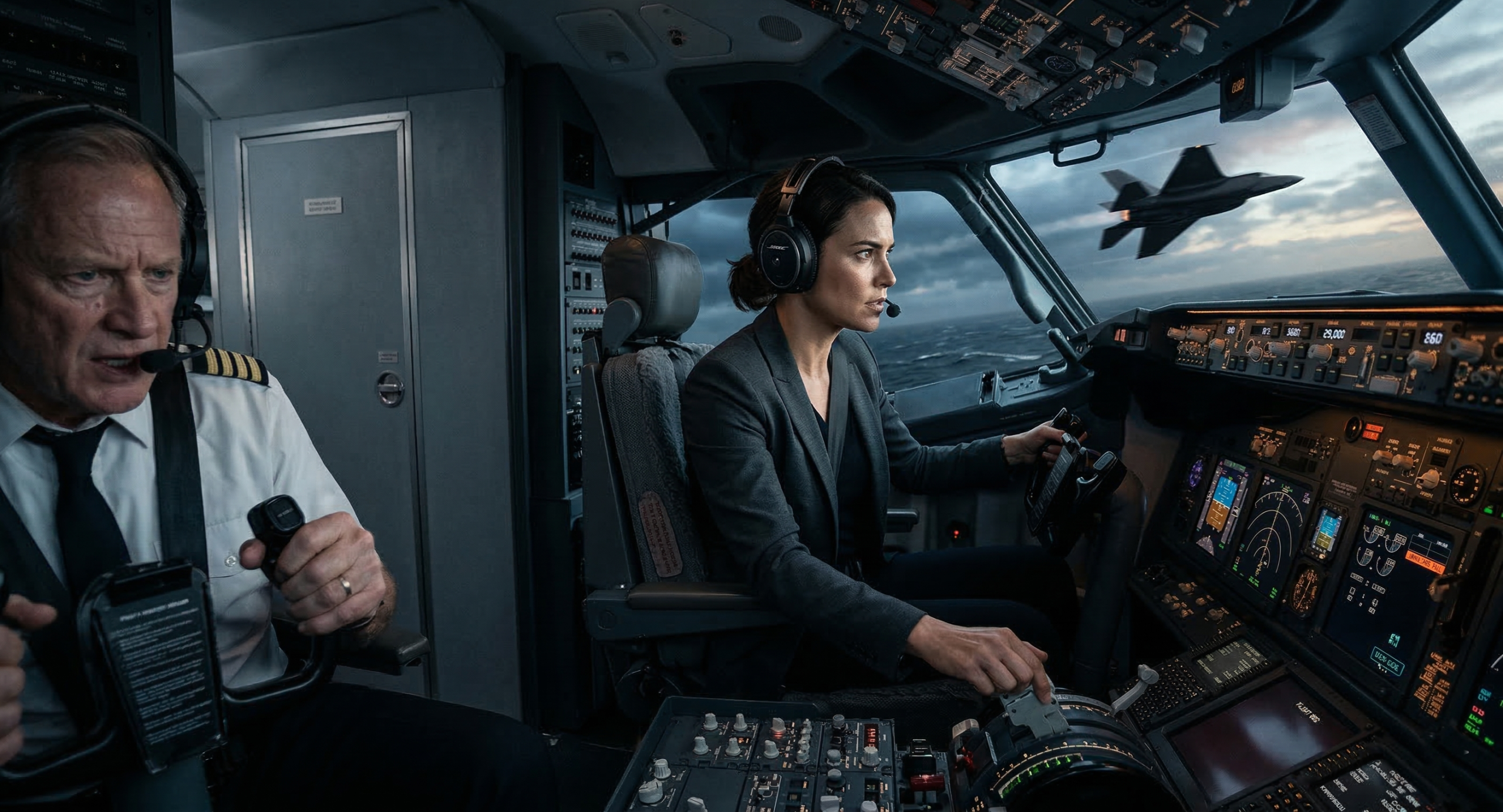
The sun was just beginning to catch the glass facades of Changi Airport, casting long shadows over the morning rush in Singapore. Amidst the sea of travelers was Elena Vance, a woman who moved with a quiet, deliberate economy of motion. Dressed in a charcoal blazer and dark slacks, she looked like any other corporate consultant heading to a mid-week briefing in Sydney.
But Elena carried a weight that didn’t show up on the airport scales.
As she settled into Seat 12F of the sprawling long-haul jet, the low hum of the engines vibrated through her boots—a frequency she once knew as intimately as her own heartbeat. For a decade, she had been a “Ghost”—an elite interceptor pilot for the Royal Air Force, specializing in high-stakes electronic warfare. She had traded the pressurized cockpit for a quiet life in data analytics, trying to silence the echoes of Mach-speed decisions.
She was drifting into the thin veil of a nap when the cabin’s intercom let out a sharp, rhythmic chime.
“Ladies and gentlemen, this is the flight deck. If there is a passenger on board with experience in advanced military flight systems or tactical aviation, please press your call button or identify yourself to a crew member immediately.”
The cabin, previously filled with the soft clinking of plastic cutlery and hushed movies, went bone-silent.
Elena’s pulse spiked. She tried to tell herself to stay seated. She had promised her family she was done with the “sharp end” of the spear. But as a head flight attendant hurried past with a look of controlled terror, Elena’s training overrode her hesitation.
“I’m a pilot,” she said, her voice cutting through the rising murmurs. “Commander Vance. Tactical Interception.”
The attendant didn’t ask for ID; she saw the sudden, iron-clad focus in Elena’s eyes. “Follow me. Now.”
Entering the cockpit was like stepping back into a dream—or a nightmare. The Captain was white-knuckling the controls, while the First Officer was frantically toggling overrides.
“Our fly-by-wire is glitching,” the Captain barked over his shoulder. “Autopilot is locked out, and something is spoofing our GPS. We’re flying blind on manual.”
Elena leaned over the pedestal, her eyes scanning the glass cockpit. She saw it instantly: a primary radar return that shouldn’t be there. “You’re not just glitching, Captain. You’re being jammed.”
She looked out the side window. Ghosting their wingtip, nearly invisible against the glare of the morning sun, was a matte-black, mid-sized jet. No markings. No lights.
“They aren’t responding to Hailer or Guard frequencies,” the First Officer whispered. “They’ve been shadowing us for ten minutes.”
“It’s a forced intercept,” Elena said, her voice dropping into a combat-ready drone. “They’re trying to herd you into a corridor where the ground radar can’t see you.”
Suddenly, the cockpit radio crackled with a distorted, synthesized voice. “Flight 882, you are in restricted airspace. Divert to Heading 190 and descend to 10,000 feet immediately. Non-compliance will be met with kinetic intervention.”
“We’re over open ocean!” the Captain shouted. “There is no restricted airspace here!”
Elena took the headset. “This is Commander Vance. You are harassing a civilian vessel in international waters. State your authority.”
The voice on the other end paused. When it returned, the distortion was gone, replaced by a chillingly familiar rasp. “Elena? I wondered if you’d be on this bird. I’ve spent three years looking for the woman who cost me my wing in the Karkhov Strait.”
Elena’s blood turned to ice. Kovak. A mercenary pilot she had downed during a forgotten border skirmish years ago. This wasn’t a hijacking; it was a vendetta.
Kovak’s black jet banked sharply, its wingtip missing their engine by mere meters. The massive airliner shuddered in the wake turbulence, sending screams echoing from the cabin.
“He’s going to clip us,” the Captain gasped. “We can’t outmaneuver a fighter in a bus!”
“We don’t have to outmaneuver him,” Elena said, sliding into the observer’s seat and slinging on a headset. “We just have to break his rhythm. Captain, give me the throttles. You keep the nose level.”
As Kovak dove for another intimidating pass, Elena didn’t turn away. She did the unthinkable: she cut the engines to idle and deployed the speed brakes. The airliner groaned as it hit a “wall” of air, rapidly decelerating. Kovak, expecting them to maintain speed or dive, surged past them like a bullet.
“Now, full power! Bank left!” Elena commanded.
While they bought themselves seconds, a new threat emerged. The intercom buzzed. “Commander! Two men in Row 15—they have a ceramic blade! They’re trying to reach the electronics bay!”
The plan was a pincer move: Kovak outside, his team inside.
But before the hijackers could reach the door, a group of passengers—led by a vacationing rugby team and a primary school teacher—rushed the aisle. They used blankets and heavy carry-ons to overwhelm the attackers, pinning them to the carpet before they could utter a word.
In the cockpit, Elena saw the radar ping. “Signal’s out. I’ve slaved the emergency transponder to the satellite link. We’re lit up like a Christmas tree on every screen from Perth to Darwin.”
Kovak realized the window was closing. He lined up for a final, suicidal ramming course.
“Not today,” Elena muttered. She waited until the very last microsecond, then signaled the Captain to execute a “slip”—dropping one wing and yawing the plane in a way no commercial pilot is ever taught to do. The black jet whistled through the space they had occupied a heartbeat before.
As Kovak pulled up to reset, two silver streaks appeared on the horizon. F-35s from the Australian Air Force, vectored in by Elena’s emergency signal.
Kovak didn’t say goodbye. He dived for the clouds and vanished from the radar.
When Flight 882 finally touched down in Sydney, the runway was lined with emergency lights. Elena waited until every passenger had deplaned before she stepped out. She didn’t want the applause or the cameras.
She looked at her hands. They weren’t shaking anymore. For years, she had thought the “Ghost” was a part of her she needed to kill to be happy. But as she watched the sun set over the terminal, she realized the truth.
Peace isn’t the absence of the struggle; it’s knowing you’re ready when the struggle finds you.
A month later, the analytics office in Singapore received a resignation letter. Commander Elena Vance wasn’t going back to spreadsheets. She was heading to a flight school—not to learn, but to train the next generation of civilian pilots on how to survive the unthinkable.
The sky was calling, and this time, she was answering for good.




One Comment on “The Ghost in Seat 12F”